
Small Team, One Enterprise-Grade Product: How We Built Security into AgentDome

- In-Perimeter Processing:AgentDome runs a collector directly inside the customer's environment - sensitive processing stays local, and only required metadata is transferred.
- Zero Public Internet Exposure: Data paths leverage private network connectivity and same-region cloud alignment rather than exposed public endpoints.
- No Stored Secrets: By utilizing native cloud managed identities, the architecture eliminates the risk and complexity of centrally storing or rotating long-lived customer credentials.
- Architecture-First Security: Small teams can build enterprise-ready software by making deliberate architectural decisions early that design out unnecessary risks.
Building a startup means making trade-offs. You have limited engineering resources, ambitious goals, and customers who expect your product to work.
Building enterprise software adds another challenge: security.
At AgentDome, we're a team of three building an AI cost optimization platform for organizations that need visibility into how their teams and AI agents use LLMs. To deliver that visibility, we operate in an environment where data can include sensitive business information, proprietary code, and internal workflows.
We knew early on that a great product wouldn't be enough. We also needed an architecture that enterprise security teams could understand, evaluate, and trust.
We didn't have a large security department or an army of engineers. Instead, we focused on three decisions that would shape the entire product.
Decision #1: Don't Move Data You Don't Need
The easiest way to build an analytics platform is to collect everything centrally and process it in the cloud.
It's also not always the right approach for enterprise customers.
AI interactions can contain sensitive information. Sending prompts and responses to an external service creates additional data exposure and raises questions about storage, access, retention, and compliance.
So we challenged the assumption that we needed that data in our central platform.
AgentDome uses a collector that runs inside the customer's environment. Sensitive processing happens there, and only the metadata required by our core platform is transferred.
This wasn't about adding another security control. It was about changing the architecture so that less sensitive data needed to leave the customer's environment in the first place.
For a three-person team, this decision also had an engineering benefit: it gave us a clear boundary between customer-side processing and our centralized application.
Decision #2: Don't Make the Public Internet Part of the Data Path
Keeping processing local solves only half the problem. The collector still needs to communicate with AgentDome's core platform.
We chose private connectivity for that communication, rather than relying on publicly exposed internet endpoints.
Encryption protects data in transit, but network isolation addresses a different question: how does the connection reach our platform in the first place?
Private connectivity gives us a more controlled network path between the customer's environment and our service. Authentication, authorization, and other security controls remain essential, but the architecture avoids making public internet access a requirement for this data transfer.
We also prioritize keeping the collector and core platform in the same cloud region whenever possible. From a security perspective, this helps keep data transfers within a defined geographic boundary, supporting data residency requirements and reducing unnecessary cross-region movement. From a cost perspective, it can significantly reduce cross-region data transfer charges and help minimize network latency.
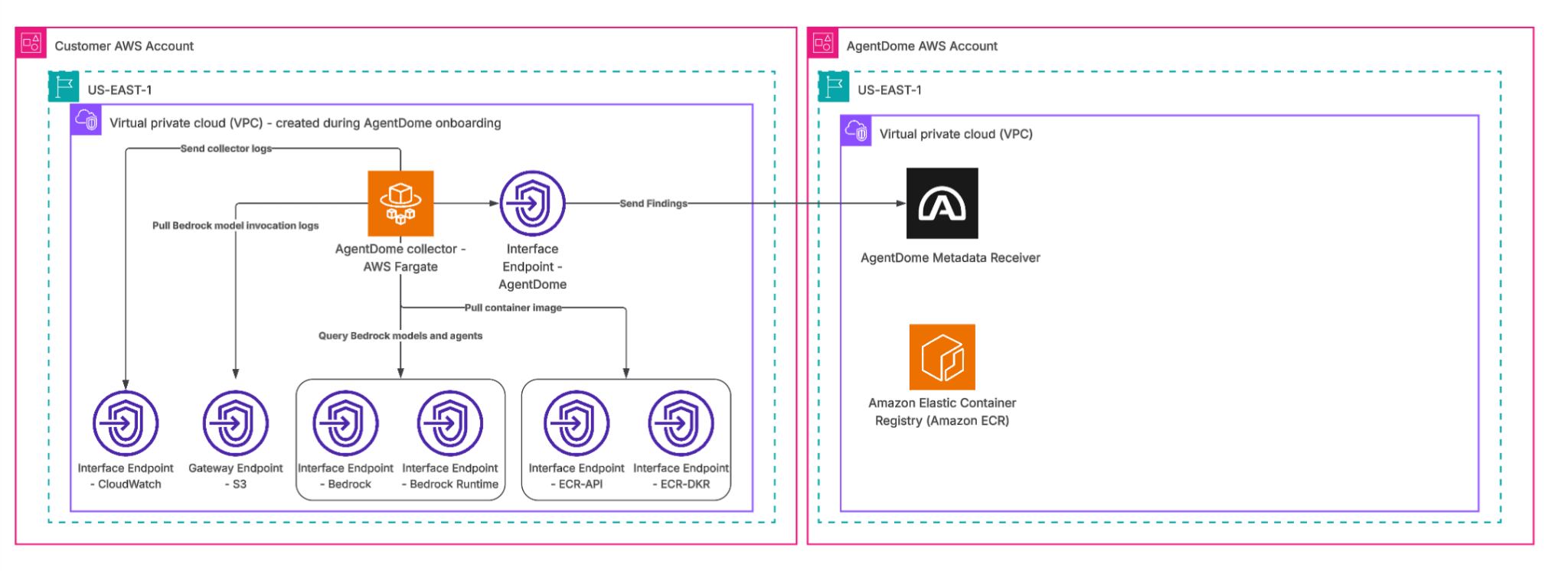
That distinction matters to enterprise security teams, particularly in environments where network access is tightly controlled. By combining private connectivity with regional alignment, we reduce unnecessary network exposure, simplify compliance considerations, and keep the architecture both more secure and cost-efficient.
Decision #3: Don't Store Secrets You Don't Need
Every integration introduces another security question: where are the credentials stored, who can access them, and how are they protected?
For a platform that operates inside enterprise environments, storing customer credentials in AgentDome's central platform would introduce another responsibility and another potential point of exposure.
We took a different approach. Instead of storing long-lived credentials on the AgentDome side, we use managed identities wherever supported.
Managed identities allow our collector to authenticate to supported services using identities managed by the underlying cloud platform, rather than relying on credentials that we generate, distribute, and maintain ourselves.
This reduces the need to store and rotate secrets, minimizes credential-handling complexity, and helps keep access tied to the identity and permissions configured in the customer's environment.
It's another example of the principle behind our architecture: the safest secret is often the one you don't need to store in the first place.
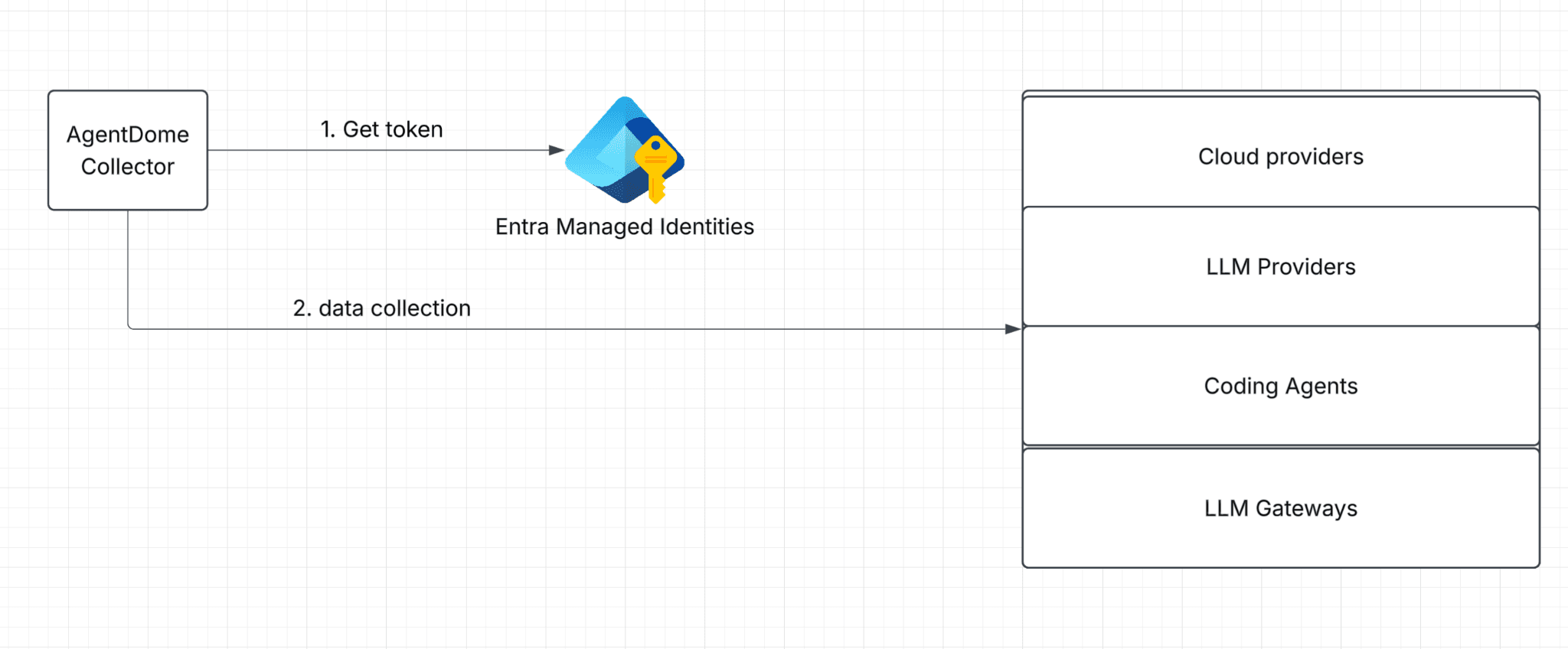
For a small team, this also means less operational overhead and fewer credentials to manage, while giving enterprise customers a clearer model for controlling access to their resources.
Security Is an Engineering Decision
These choices weren't made to create a marketing claim. They were made because we wanted to build a product that could operate within the constraints of enterprise environments.
Of course, architecture alone doesn't pass a security review. Organizations also evaluate identity and access management, vulnerability management, operational processes, incident response, and many other controls.
But architecture determines the questions you need to answer later.
We believe a small startup can build enterprise-ready software without replicating the size of an enterprise engineering organization. The key is to make deliberate decisions early, keep the system understandable, and invest effort where it meaningfully reduces risk.
At AgentDome, that means starting with a simple question: How can we deliver the value customers need without requiring them to give up control of their environment?
That question continues to guide how we build.
Learn more about AgentDome at agentdome.io.